


How can the true value of PR be measured today? And why is counting articles and AVE no longer enough?
These were among the key questions addressed at an expert seminar organized by the Association of Public Relations (APRA) in cooperation with NEWTON Media. The first meeting within the Measurement Initiative 2026 took place on April 16 at the Czech News Agency Press Centre in Prague, offering not only an international perspective but also practical experience from the Czech market. It also delivered a clear recommendation: measurement must become an integral part of communication management, not merely a tool for its retrospective evaluation.
PR Under Pressure: Data, Trust, and Business Results
The public relations industry has long faced one fundamental challenge: there is no universal agreement on how to accurately define its value. While company leadership expects clear data and a direct connection to business results, PR teams often work with metrics that fail to demonstrate this link convincingly.
The seminar therefore opened a crucial discussion about shifting from measuring outputs to measuring outcomes and impact. In other words, placing less emphasis on “how much was published” and greater focus on “what it actually changed.”

Technology Changes the Tools, Not the Principles

The keynote speech was delivered by Johna Burke, a leading expert in communication measurement from the international association AMEC. Her message was clear: although tools and technologies — including AI — are fundamentally transforming analytical capabilities, the foundation of quality measurement remains critical thinking and sound methodology.
The key is to properly understand the context — the “who, what, where, and when” — and only then build impact evaluation and strategy on that basis.
“Start with objectives. Just as you wouldn’t go on vacation without a clear plan, you shouldn’t start a campaign before defining where you are heading and what your goal is.”
— Johna Burke, CEO of AMEC
The Barcelona Principles as a Compass
A significant part of Johna Burke’s presentation focused on the so-called Barcelona Principles, which today serve as the fundamental framework for PR measurement. Several key principles were highlighted:
- objectives must be clearly defined and measurable already during the planning phase,
- it is essential to deeply understand target audiences,
- measurement must combine both quantitative and qualitative data,
- the focus is shifting toward outcomes and their connection to business performance.
Importantly, the principles do not prescribe a strict methodology. Instead, they provide a framework that helps organizations choose meaningful metrics and avoid misleading results.
The End of AVE, the Rise of Complex Frameworks
One of the frequently discussed topics was the gradual “death” of the AVE (Advertising Value Equivalent) metric. Today, it is considered outdated because it cannot accurately capture the real impact of communication.
However, according to a recent survey by NEWTON Media among Czech PR professionals, 51% of respondents still use it, mainly because it is easily understandable for management.
Nevertheless, more complex approaches are increasingly being adopted, such as:
- the Integrated Evaluation Framework (IEF) for linking objectives, activities, and outcomes,
- the Measurement Maturity Mapper (M3) as a tool for assessing the maturity level of measurement within an organization.
These frameworks make it possible to systematically connect PR with business objectives and better communicate its value to management.
The Reality of PR Measurement in the Czech Republic
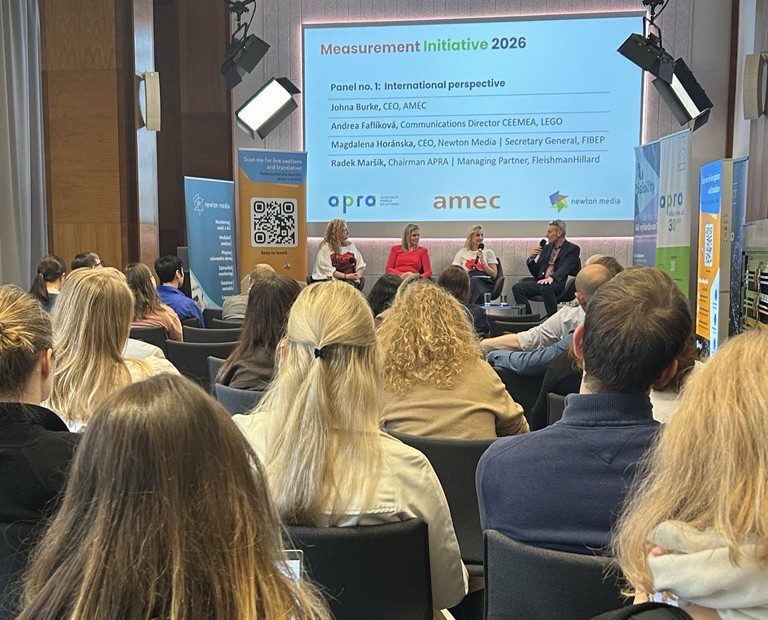
The panel discussion, moderated by Radek Maršík (APRA), and featuring Andrea Faflíková (LEGO) and Magdalena Horánska(NEWTON Media, FIBEP), showed that Czech practice is still in a transitional phase.
Many companies and organizations continue to rely on metrics such as the number of media outputs or reach. At the same time, however, there is growing pressure to:
- link PR measurement with business KPIs,
- measure impact on reputation and audience behavior,
- use data for real decision-making.
It was also emphasized that there is no single universal number that can fully capture the value of PR. The key lies in combining metrics, context, and qualitative insights derived from a company’s communication objectives.
The subsequent discussion also brought in the perspective of the public sector, shared by Jan Hainz from the Digitální informační agentura.
The public sector faces specific challenges, including:
- a strong emphasis on transparency,
- limitations in working with data and budgets,
- the need to demonstrate contribution to public trust.
Here too, systematic measurement is gaining importance, for example through a combination of media analysis and research data.
AI as a New Communication Channel
Another topic discussed was artificial intelligence — not only as a tool for data analysis, but also as a new communication channel through which content reaches audiences. This brings increasing attention to how, and whether, brands or messages appear in outputs generated by AI tools.
For PR professionals, this means learning to operate in an environment where not only information distribution is changing, but also what influences public perception and how it is shaped.
How to Use Insights in Practice
The seminar provided several clear recommendations:
- start with defining objectives and target audiences,
- integrate measurement already into campaign planning,
- combine data across channels (PESO model),
- use frameworks such as M3 and IEF,
- build dashboards with actionable insights,
- systematically educate both teams and management.
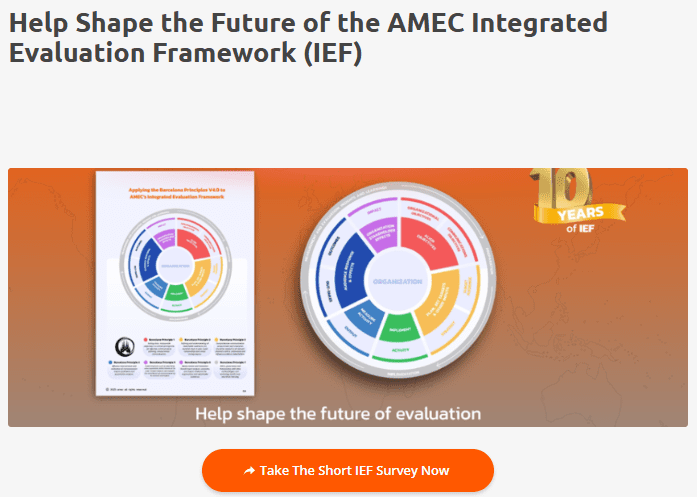
The PESO model uses Paid, Earned, Shared, and Owned media to distribute and measure content in order to build relationships with the public. It was popularized by Gini Dietrich, CEO of the PR agency Arment Dietrich, in her book Spin Sucks.
Next Steps in the PR Measurement Initiative 2026
The initiative focused on PR measurement will continue through further activities and knowledge sharing.
A follow-up session titled How to Demonstrate the Value of PR Through Effective Measurement is scheduled for May 26. Once again, it will take place at the Press Centre of the Czech News Agency (ČTK), where participants will welcome Amrita Sidhu, head of the Australian agency Medianet and a member of the global board of AMEC.
She will demonstrate how to turn measurement into a strategic tool—and how to finally bring PR to the decision-making table where key business decisions are made.